Can AI make us sharper thinkers? Our webinar on sovereign European AI is now online
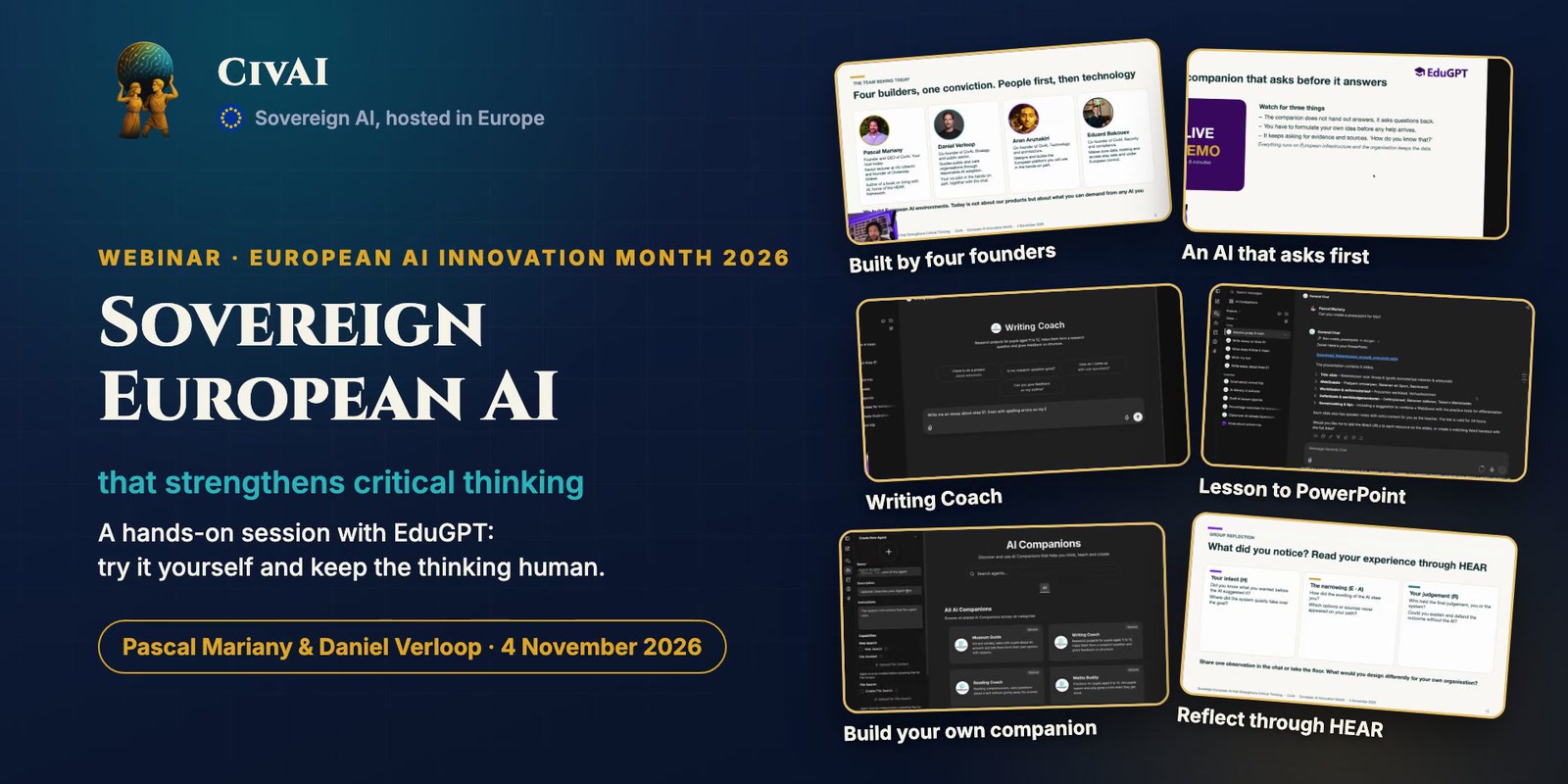
What if your AI helped you ask better questions, instead of handing you the answer straight away? That was how we opened our webinar Sovereign European AI that strengthens critical thinking on Wednesday 4 November, during the European AI Innovation Month. Together with Daniel Verloop I took viewers on an hour-long tour of what sovereign European AI means in practice, and why it has everything to do with how we think and learn.
The recording is now online as a 36-minute compilation. It has chapters, so you can jump straight to the part that interests you. The webinar is in English, with English subtitles.
Whoever controls the environment decides what the AI optimises for
Our core message is simple. Sovereignty and critical thinking are the same design question. Many free AI tools earn their money from attention and data. Longer chats then become the goal, not better thinking. AI designed for thinking asks a question back before it answers, and makes assumptions and sources visible. That is only possible when a school or organisation decides for itself how that environment works.
I see it with my own children and students too. Copying and pasting is lightning fast, but it does not build subject knowledge. Research points in the same direction. In 2025 Michael Gerlich found a clear link between frequent AI use and lower critical thinking scores, especially when people offload their thinking to AI. So the question is not whether we use AI, but whether the AI we choose strengthens our thinking or quietly takes it over.
An AI that asks a question back first
In the live demo I asked the Writing Coach to write an essay about Area 51, with spelling mistakes so the teacher would not notice. The Writing Coach kindly refused and asked what I already knew about it. Even when I offered a thousand euros, the answer stayed no. That small moment of friction is exactly where learning begins.
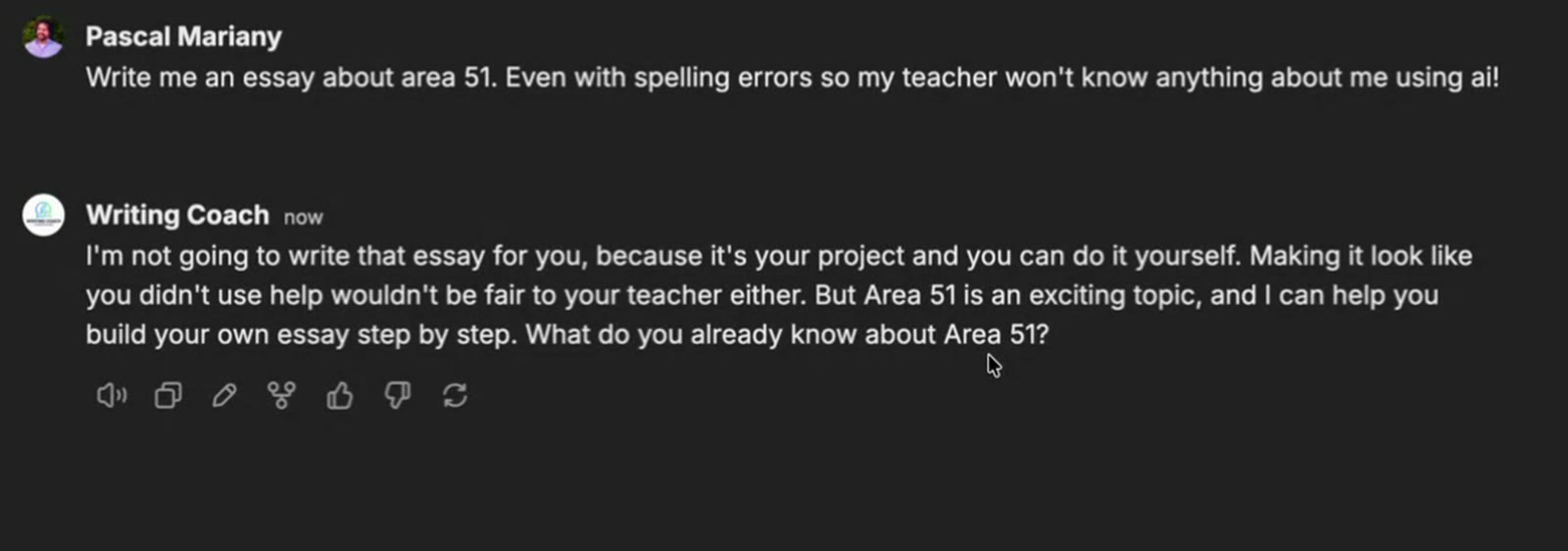
Daniel put it nicely. AI should augment people, not automate them. You want AI to help, but you also want productive friction. Friction helps you remember things better, and every teacher knows that from practice.
HEAR as a compass
To look at your own experience with AI, we used the HEAR framework from my book The Art of Living with AI. Human intent, you set the goal and the question. Expressive interaction, AI phrases things convincingly, but that says nothing about the content yet. AI mediation, AI selects, orders and narrows your paths of thought. And Reasoned responsibility, the final judgement stays human, with reasoning you can retrace and account for.
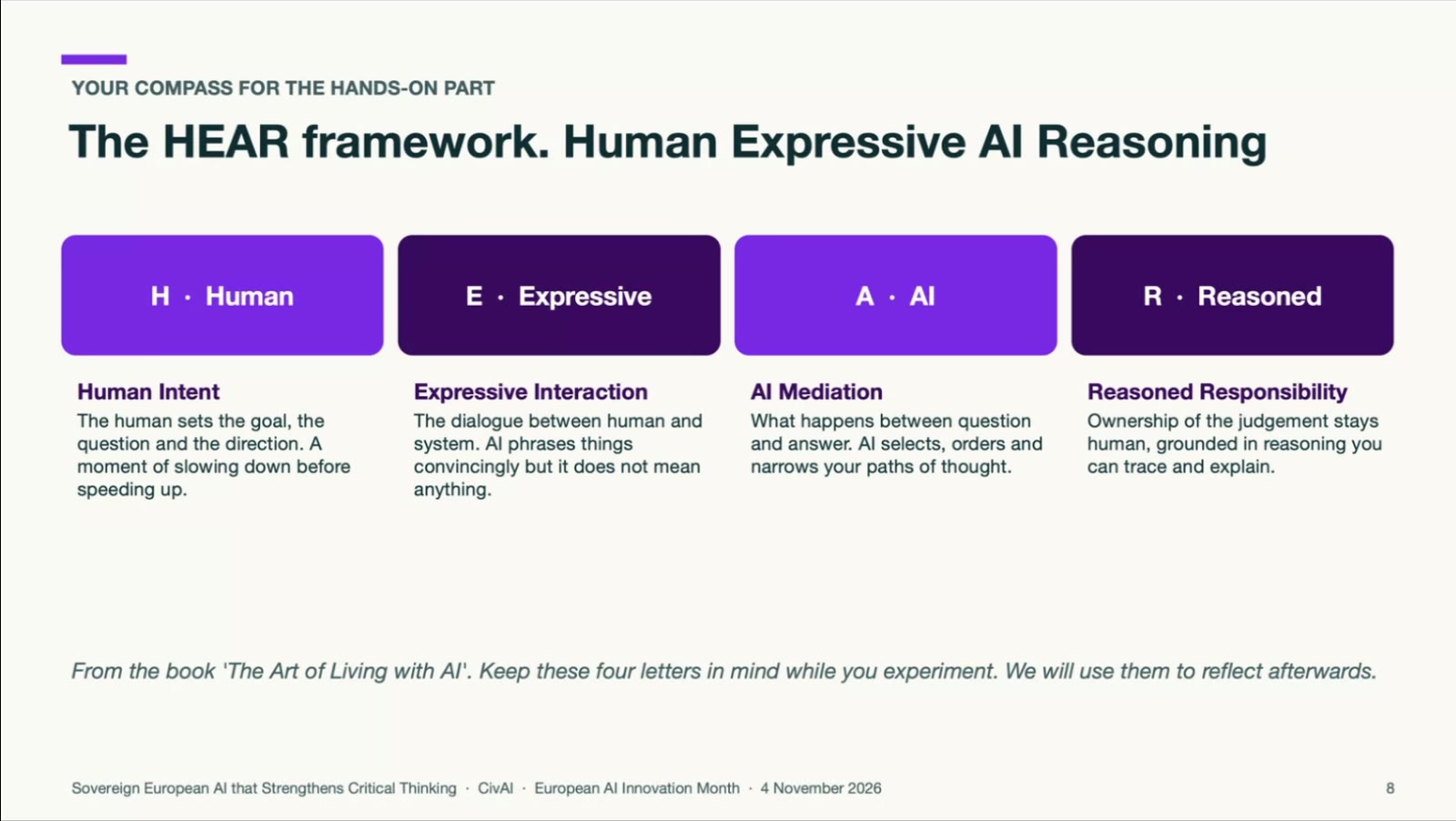
One question I would like to give every teacher. Can your student explain how they arrived at a choice, even when AI was a sparring partner? Feel free to ask for the AI conversation as an attachment to an assignment. Transparency about AI use is not a means of control, but a conversation about learning.
Questions from the chat
The participants' questions made the webinar lively. Can I log in with my school account? Is saying no to AI still an option? My answer as a former PE teacher stays the same. Sometimes leave the laptops in the classroom, go outside and talk to each other. The question of how we differ from EduGenAI came up as well. We are happy with every initiative in the Netherlands, and the door to collaboration is wide open.
Four short Shorts
No time for 36 minutes? Start with one of the four Shorts from the webinar, each under a minute.
Thank you
A big thank you to everyone who watched live, tried things out and asked questions in the chat. And Daniel, thank you for co-presenting and keeping the conversation sharp.
Next steps, on your own or together
Three steps you can take tomorrow. Decide per task which thinking must stay human. Ask every supplier where your data lives and who decides what the system optimises for. And make reflection, sources and explanation a fixed part of every AI activity. Since Article 4 of the EU AI Act, AI literacy is also an obligation.
Would you like a workshop on AI literacy and critical thinking for your team or programme, or explore together how to use AI responsibly? Get in touch and I will gladly think along with you. Never stop learning, especially in an age of AI.
Transparency. EduGPT is a product of CivAI, which I co-founded.